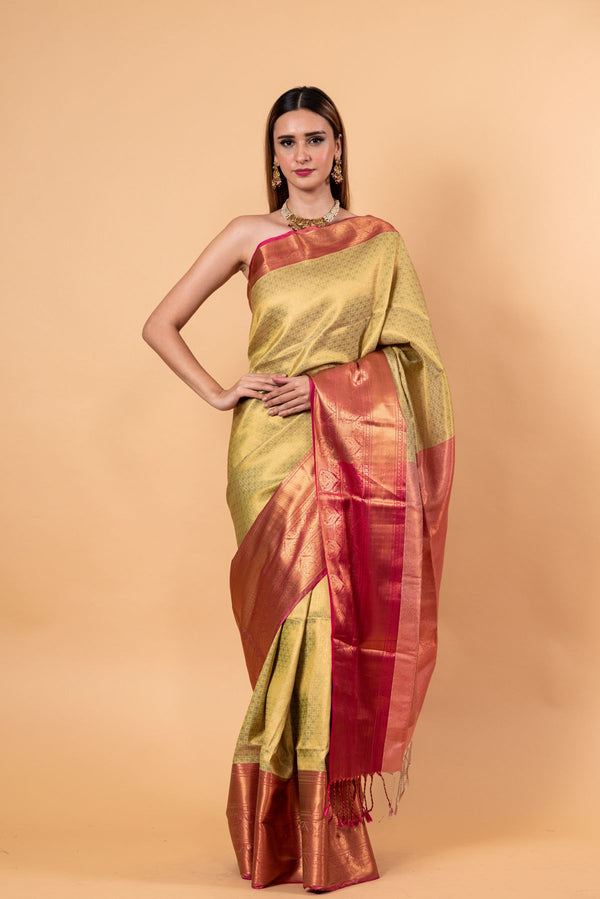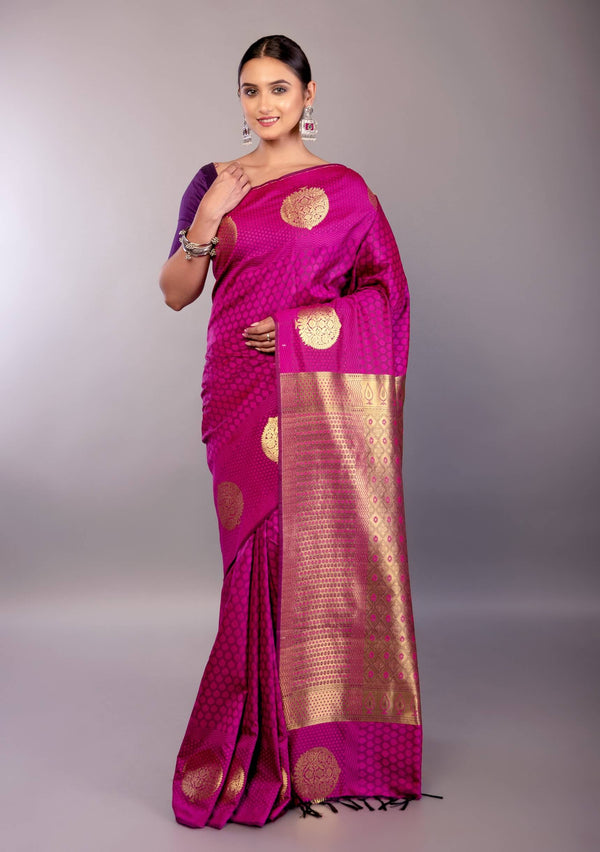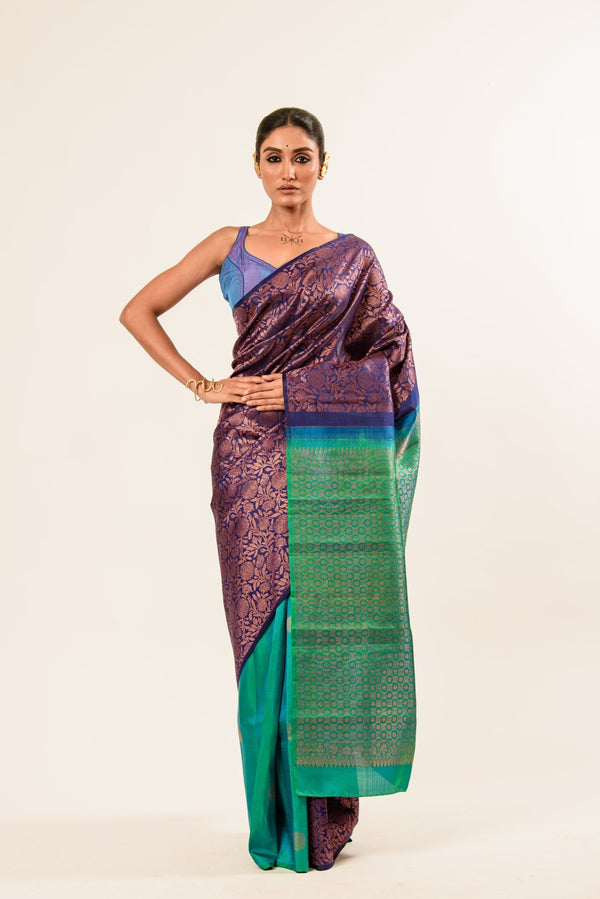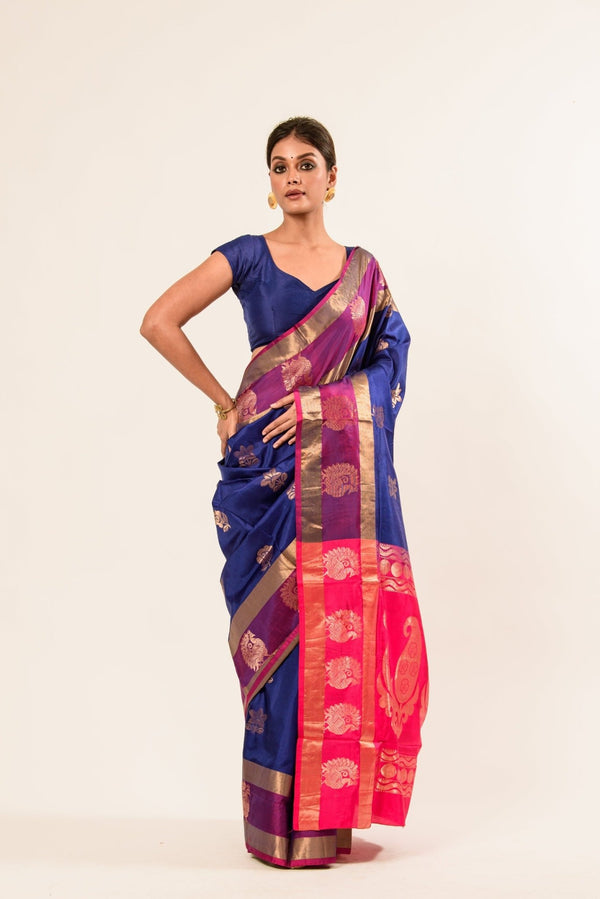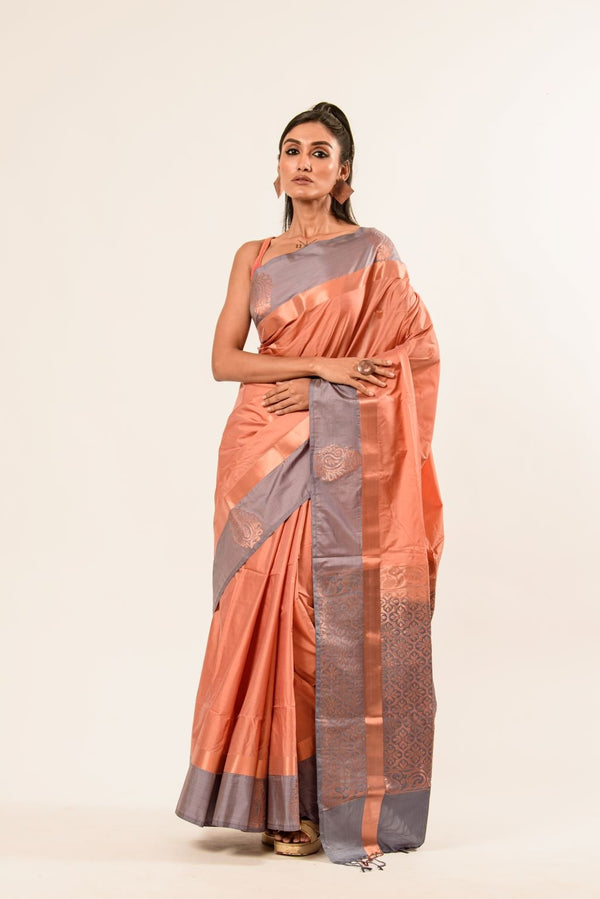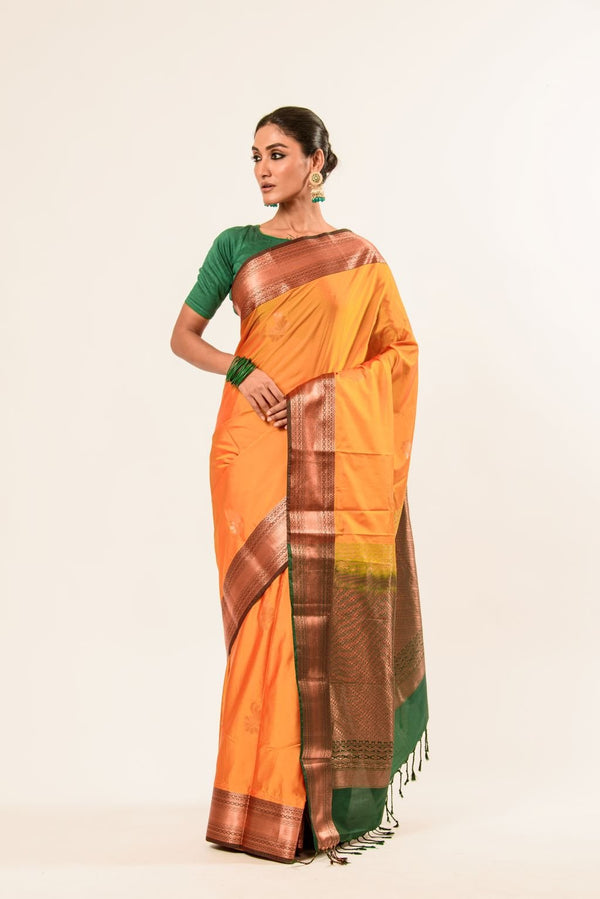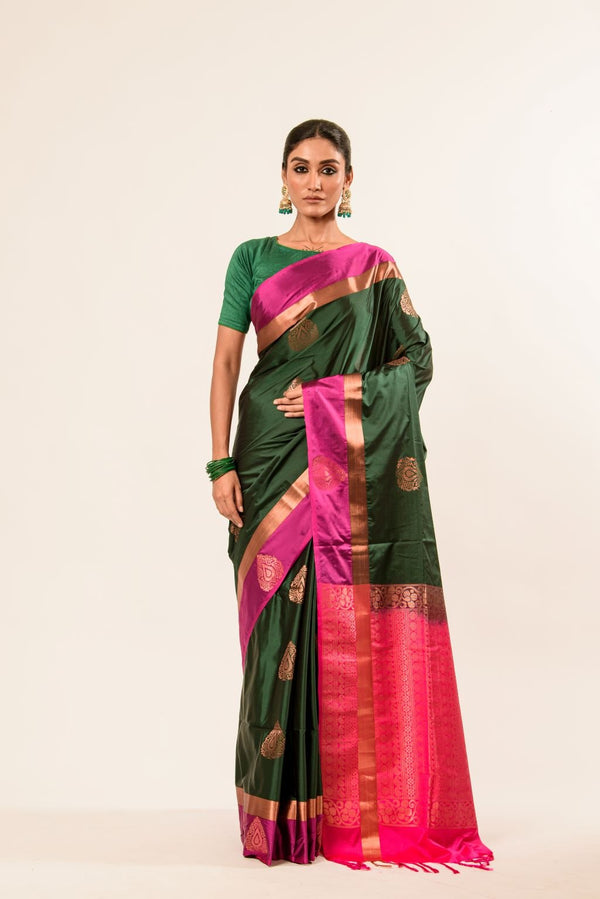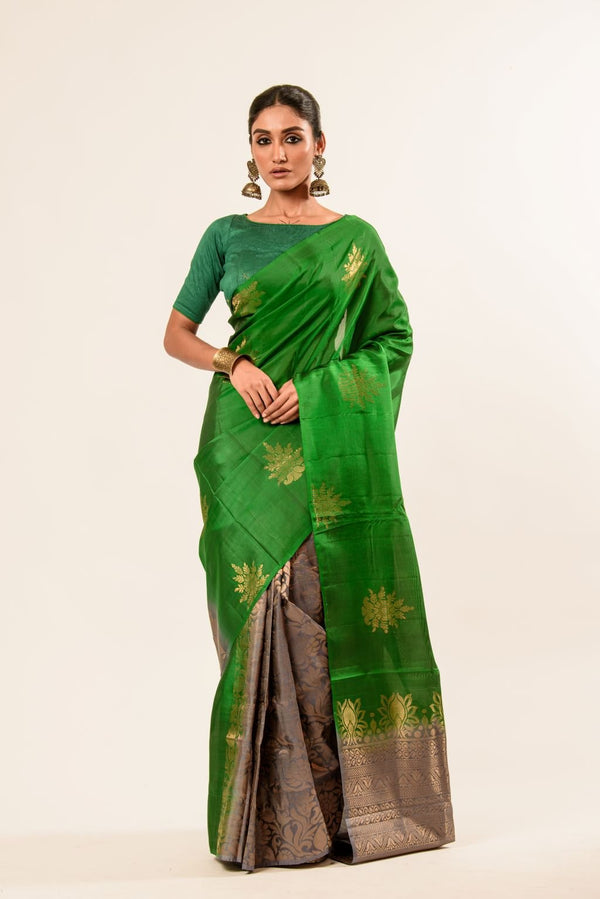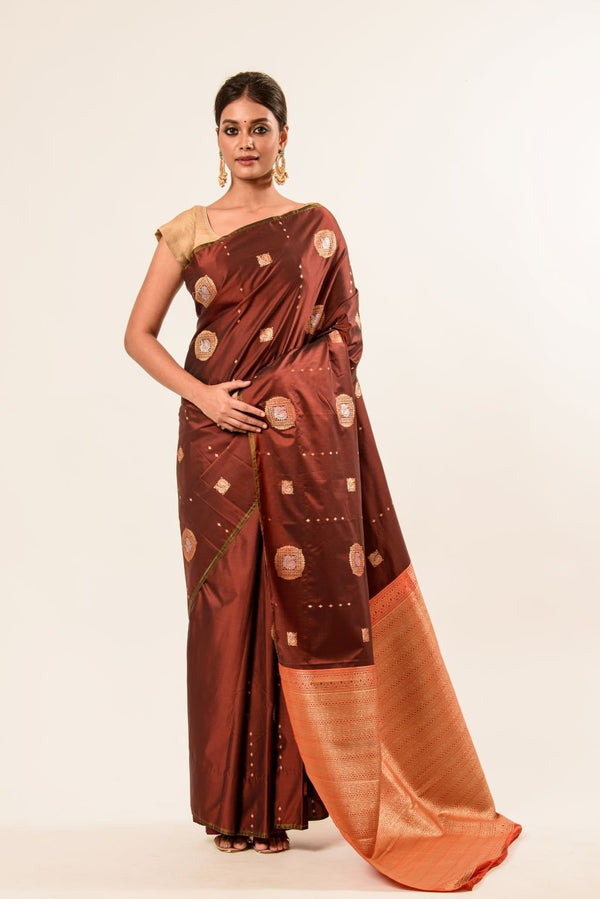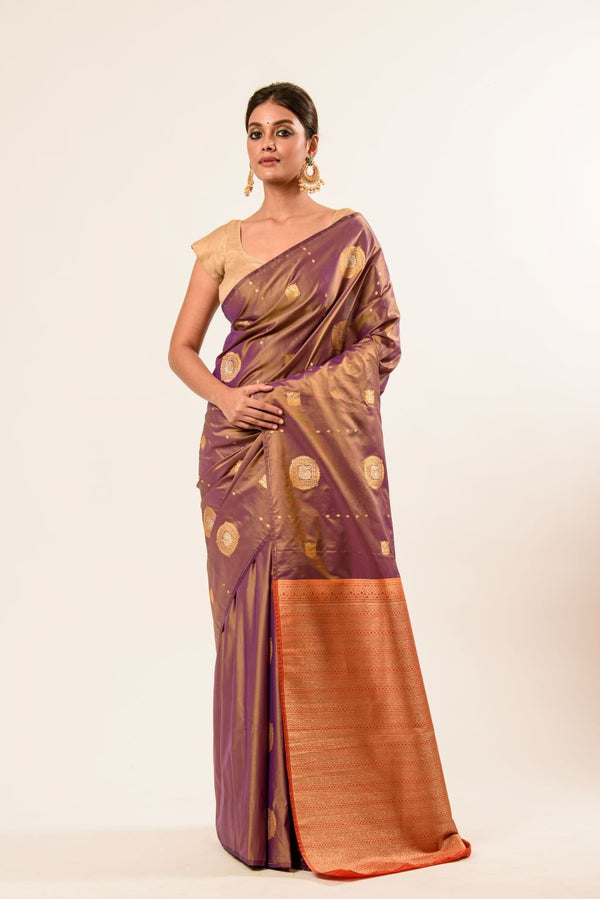




Ever wondered why two Kanchipuram silk sarees can look so different, even though both belong to the same weaving tradition? One may have a striking contrast border, another may feature intricate temple patterns, while a third catches your eye with its peacock motifs or richly woven pallu. Each design has something interesting to tell. But how do you recognise these differences, and which type should you choose? From traditional Korvai weaves to distinctive borders and motifs, this guide explores the different types of Kanchipuram silk sarees, what makes each one special, and how to find a design that suits your style and occasion.
How Are Different Types of Kanchipuram Silk Sarees Classified?
Kanchipuram sarees, also called Kanjivaram sarees, are traditionally woven in Kanchipuram, Tamil Nadu. Their designs are influenced by South Indian textile traditions, temple architecture, and skilled silk weaving. There is no fixed number of Kanchipuram saree types. A single saree can feature a Korvai border, peacock motifs, a checked body, and a contrasting pallu.
The following table explains how these sarees are commonly classified.
| Classification | Popular types | Main characteristics |
| Weaving techniques | Korvai, Petni | Methods used to construct contrasting borders and pallus |
| Border designs | Temple, contrast, Rudraksham, zari | Patterns and detailing along the saree edges |
| Traditional motifs | Peacock, lotus, mango, elephant | Decorative designs inspired by nature and tradition |
| Body patterns | Checks, stripes, buttas | Patterns woven across the main body |
| Pallu designs | Contrast pallu, zari pallu | Colour combinations and decorative weaving at the saree's end |
The easiest way to understand these differences is to examine the saree's construction first, followed by its borders, motifs, and pallu.
Types of Kanchipuram Sarees Based on Weaving Techniques
Traditional Kanchipuram sarees are known for their weaving techniques, particularly the methods used to join contrasting borders and pallus. Two important techniques are Korvai and Petni.
1. Korvai Kanchipuram Silk Sarees
Korvai is a traditional weaving technique used to create contrasting borders in Kanchipuram silk sarees. In this method, the saree body and borders are woven using separate sets of yarns that are interlocked during weaving. Traditional Korvai weaving often involves multiple shuttles and requires considerable skill.
How to recognise a Korvai saree:
-
The border usually has a contrasting colour.
-
The border and body are joined through the weaving process.
-
The border may feature temple patterns, zari work, or traditional motifs.
-
The woven join can be examined from the reverse side of the saree.
Korvai Kanchipuram sarees are particularly popular for traditional weddings and religious ceremonies because of their distinctive borders and rich appearance.
Buying tip: Not every Kanchipuram saree with a contrasting border is woven using Korvai. If traditional Korvai craftsmanship is important to you, ask the seller about the weaving technique.
2. Petni Pallu Kanchipuram Silk Sarees
Petni is a traditional weaving technique associated with creating a contrasting pallu in Kanchipuram sarees. The pallu is the decorative end of the saree that usually falls over the shoulder. In Petni weaving, a different set of weft yarns is introduced to create a pallu that contrasts with the main body.
How to recognise this style:
-
The pallu has a different colour from the saree body.
-
The transition between the body and pallu is part of the woven construction.
-
The pallu may feature detailed zari patterns or traditional motifs.
For example, a green Kanchipuram saree may have a red pallu with golden zari detailing. However, a contrasting pallu alone does not confirm that the saree uses the Petni technique. Petni-style contrast pallus are a good choice for women who prefer traditional sarees with a prominent pallu design.
3. Kanchipuram Sarees with Non-Korvai Borders
Not all Kanchipuram sarees use traditional Korvai border construction. Some contemporary designs have borders woven using other arrangements. These sarees may feature matching borders, contrasting colours, or decorative zari patterns. They can be suitable for women who prefer coordinated designs or a less contrasting appearance. The important difference is in the construction, not simply the colour of the border.
Remember: Korvai describes a weaving technique, while a contrast border describes a visual feature. They are not interchangeable terms.
Types of Kanchipuram Sarees Based on Border Designs
Borders are among the most noticeable features of a Kanchipuram silk saree. Their width, colour, patterns, and zari detailing can completely change the appearance of the saree.
Here are four popular Kanchipuram saree border designs.
1. Temple Border Kanchipuram Sarees
Temple-border Kanchipuram sarees feature geometric patterns inspired by South Indian temple architecture. These borders often have repeated triangular or stepped shapes resembling temple structures.
Key features:
-
Triangular or geometric border patterns.
-
Traditional designs inspired by temple architecture.
-
Narrow or broad borders.
-
Contrasting colours or zari detailing.
Temple-border Kanchipuram sarees are a popular choice for weddings, pujas, and traditional family celebrations. If you prefer a saree with a strong traditional South Indian character, a temple-border design is worth considering.
2. Contrast Border Kanchipuram Sarees
Contrast-border Kanchipuram sarees have borders in a different colour from the main body. For example, a royal blue saree may have a pink border, while a yellow saree may feature a green or red border. The contrast helps define the saree's overall appearance and makes the border more noticeable when draped.
Popular traditional colour combinations include:
-
Red and green.
-
Blue and pink.
-
Yellow and maroon.
-
Purple and gold.
These combinations are examples rather than fixed rules.
Best for: Weddings, festivals, and occasions where you want a saree with a noticeable colour contrast.


3. Rudraksham Border Kanchipuram Sarees
Rudraksham borders feature repeated patterns inspired by Rudraksha beads. These small decorative shapes are arranged along the saree border to create a continuous traditional pattern. Rudraksham designs may appear alongside zari lines, geometric patterns, or other woven details.
How to recognise them: Look for a series of repeated bead-like motifs running along the border.
Best for: These sarees are suitable for women who appreciate traditional motifs without necessarily choosing a heavily patterned saree body.
4. Zari Border Kanchipuram Sarees
Zari-border Kanchipuram sarees feature metallic-looking threads woven into the borders. The zari may form broad decorative bands, floral patterns, geometric designs, or traditional motifs. Some sarees have narrow zari borders, while others feature broad borders that occupy a significant part of the design. A broad zari border can create a rich ceremonial appearance, while a narrow zari border can provide a more restrained finish.
Buying tip: Zari can vary in material composition. A golden appearance does not automatically mean the zari contains real gold or silver. Check the product details before purchasing.


Traditional Kanchipuram Saree Motifs and Their Meanings
Motifs are decorative patterns woven into a saree's body, border, or pallu. Traditional Kanchipuram saree motifs often draw inspiration from nature, temple architecture, and South Indian cultural traditions. Understanding these motifs can help you recognise different Kanchipuram saree designs.
| Traditional motif | How to recognise it | Common design association |
| Peacock | Bird-shaped patterns with decorative feathers | Grace, beauty, and traditional art |
| Lotus | Open flower or repeated petal patterns | Purity and cultural symbolism |
| Rudraksham | Small bead-inspired patterns | Religious and spiritual traditions |
| Gopuram | Geometric patterns inspired by temple towers | South Indian temple architecture |
| Mango or paisley | Curved, mango-shaped designs | Traditional Indian textile patterns |
| Elephant | Elephant-shaped woven motifs | Royal and ceremonial imagery |
| Floral buttas | Small, repeated flower patterns | Decorative floral weaving |
Peacock and Lotus Motifs
Peacock motifs are commonly used in traditional silk saree designs. They may appear individually or as repeated patterns across the border and pallu. Lotus motifs are another familiar element of Indian textile design. They can appear as small woven flowers or larger decorative patterns. Both are suitable for women who prefer traditional sarees with nature-inspired detailing.

Rudraksham and Gopuram Motifs
Rudraksham motifs are recognised by their bead-inspired shapes, while Gopuram designs draw inspiration from South Indian temple towers. These motifs are particularly associated with traditional temple-inspired textile patterns. They are worth exploring if you prefer a Kanchipuram saree with geometric designs and cultural references.
Mango, Elephant and Floral Motifs
Mango or paisley motifs have curved shapes and are widely used in Indian textile traditions. Elephant motifs may appear in ceremonial or traditional designs, while floral buttas create repeated decorative patterns across the fabric. If you prefer a saree with fewer large motifs, a design featuring small floral buttas can be a suitable option.
Styling tip: Sarees with large motifs or detailed borders often look well with a simpler blouse. For sarees with smaller, widely spaced motifs, you can experiment with a more detailed blouse design.


Popular Kanchipuram Saree Body Patterns and Pallu Designs
Apart from weaving techniques, borders, and motifs, Kanchipuram sarees can also be distinguished by their body patterns and pallu designs.
Here are four popular styles.
1. Checked Kanchipuram Silk Sarees
Checked Kanchipuram sarees feature intersecting lines that create square or rectangular patterns across the body. The checks may be small and closely arranged or larger and more noticeable. Traditional checked designs can be paired with contrasting borders and detailed pallus.
Choose this style if: You like geometric patterns and traditional silk sarees with a structured design.

2. Striped Kanchipuram Silk Sarees
Striped Kanchipuram sarees feature woven lines arranged across the fabric. The stripes may vary in width, colour, and spacing, creating different visual effects. Some designs combine stripes with contrasting borders or decorative pallus. These sarees are suitable for women who prefer linear patterns instead of floral or animal motifs.
3. Butta Design Kanchipuram Sarees
Buttas are small decorative motifs repeated across the saree body. They may feature flowers, leaves, peacocks, or geometric shapes. Some sarees have closely arranged buttas, while others feature widely spaced motifs that leave more of the silk fabric visible.
Choose this style if: You prefer a saree with traditional detailing but do not want the entire body covered in large patterns.
4. Contrast Pallu Kanchipuram Sarees
A contrast-pallu Kanchipuram saree features a pallu that differs in colour from the main body. For example, a pink saree may have a green pallu with detailed zari work. The pallu may also feature larger motifs or denser decorative weaving than the saree body. This style is particularly suitable for occasions where the pallu is arranged prominently over the shoulder. A contrast pallu describes the saree's appearance; it does not necessarily mean that the Petni technique was used.


How to Choose the Right Type of Kanchipuram Silk Saree
Choosing a Kanchipuram silk saree becomes easier when you understand its weaving technique, border design, and motifs. Start by considering the occasion, the type of design you prefer, and how you plan to drape the saree.
The following table can help you compare different options.
| Kanchipuram saree type | Main design feature | Suitable occasions |
| Korvai contrast-border saree | Distinctive woven border | Traditional weddings and ceremonies |
| Temple-border saree | Temple-inspired geometric patterns | Pujas, weddings, and cultural celebrations |
| Broad zari-border saree | Prominent zari detailing | Wedding receptions and formal celebrations |
| Checked Kanchipuram saree | Geometric body patterns | Festivals and family gatherings |
| Butta-design saree | Repeated small motifs | Festive occasions and traditional events |
| Contrast-pallu saree | Distinctive pallu colour and design | Weddings and special occasions |
Consider the Border and Pallu
If you prefer a traditional saree with a prominent border, explore Korvai or broad zari-border designs. For a saree with a more coordinated appearance, consider matching borders or smaller woven patterns. If you like highlighting the pallu while draping, a contrasting pallu with detailed motifs can be a good choice.
Pay Attention to the Body Pattern
Checked and striped Kanchipuram sarees are suitable for women who enjoy geometric patterns. If you prefer floral or traditional decorative details, look for sarees featuring buttas, peacocks, lotus patterns, or other woven motifs. Also consider how densely the motifs are arranged. A saree with small, widely spaced motifs will look different from one featuring large patterns across the body.
Check the Fabric and Product Details
Before choosing a Kanchipuram saree, check its fabric composition, weaving details, zari description, and product photographs. A traditional design alone does not confirm the material or weaving technique. If you are shopping online, examine close-up photographs of the border, body, and pallu. Ask the seller for additional details if the product description does not explain the fabric or construction clearly.